Why Your Website Visitors Aren’t Booking: The Power of User Guidance
I’ll be the first to admit it: my very first business website was a masterpiece of "pretty."
It had stunning photography, elegant videos, and fancy moving elements that drifted across the screen. I was so proud of it.
I thought I had built the perfect digital home for my services.
But there was one major problem:
No one was calling.
Visitors would land on the page, look at the beautiful pictures for a few seconds, and then leave.
I hadn't given them a map; I had given them a maze of "fancy" distractions that led nowhere.
I learned the hard way that to grow my business, I had to stop "decorating" with fancy stuff and start designing for the user.
Designing for the "Distracted User" Path
Now, when I plan or design a website for a client, I don’t start with colors. I start with the Path.
I design with a very specific person in mind: the multitasking entrepreneur.
This person isn't studying your website with 100% focus. They are likely on a video call, scrolling while making dinner, or holding a toddler in their arms.
If I make that person "hunt" for the information they need, I’ve failed them.
My job as a designer is to make the journey from "Visitor" to "Booked Client" as short and effortless as possible.
When the path is easy, the decision to click "Book" becomes easy too.
The "Brochure Trap": Why Pretty or Fancy Isn’t Enough
I see this "Brochure Trap" constantly with high-end service providers.
They have websites that look like luxury magazines, stunning portfolios, elegant white space, and professional photography.
But from a user perspective, these sites are often a dead end.
There is a massive "value gap" between a visitor admiring your work and a visitor knowing how to hire you.
If you just present "beautiful stuff" without organizing it into easy-to-consume steps, you are asking your busy visitor to do too much work.
To turn a brochure into a business-building tool, you need a clear "bridge" between your portfolio and your contact form.
How I Use UX Design to Build Conversion Paths
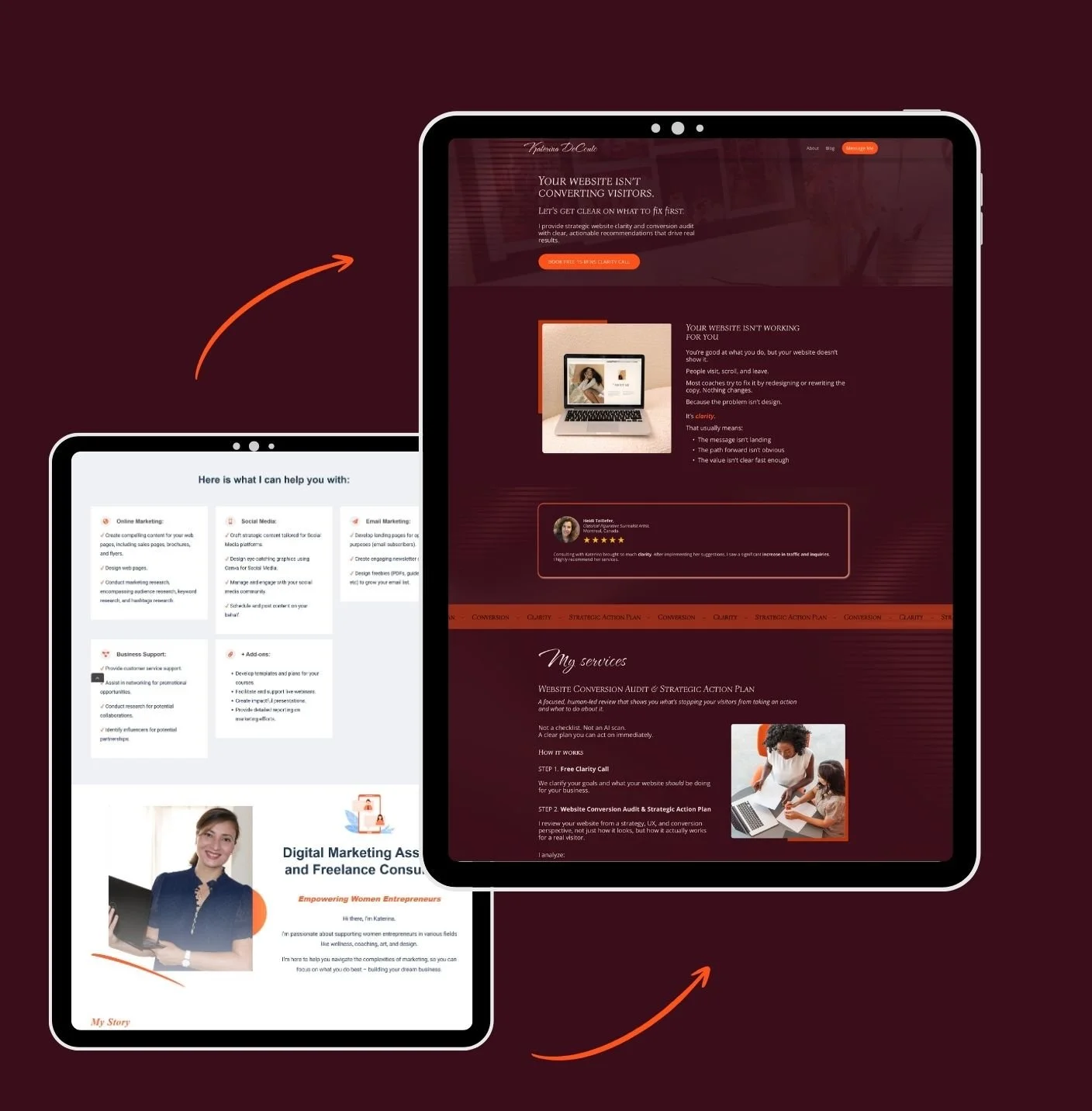
When I work on a project, I combine my MBA strategy with UX (User Experience) principles to ensure your site isn't a leaky bucket that loses potential clients. I focus on three core pillars:
Content with Intent: I don't just "put a fancy stuff" on a page. I structure the copy so it guides the user toward a solution. If they want to learn about you, I show them the information that builds trust.
Visual Hierarchy: I use font sizes, colors, and layouts to "point" the eye. I make sure the most important information, the thing that helps them make a decision, is the easiest to see.
The "Unmissable" Button: In the past, I made my buttons "blend in" to look chic. Now, I ensure my main Call to Action is big, bright, and unmissable and looks like it’s begging to be pressed.
Clarity Over Beauty
Throughout my journey, from earning my MBA to building a yoga business, marketing consultancy and now my professional studies in UX, I’ve learned that the most successful businesses aren't the loudest; they are the clearest.
I’m not another "guru" on the internet who has it all figured out; I’m someone who made the mistake of choosing "fancy" over "functional" and realized it was costing me clients.
Now, I use that experience to make sure your website works as hard as you do.
Is your website a maze or a map?
If you want your visitors to have the shortest, easiest way to book with you, let’s talk.
I offer a Free 15-30-minute Website Strategy Consultation.
We’ll jump on a call, look at your page structure, and discuss your unique business challenges.
It’s a low-pressure way to find the "fancy" distractions and replace them with a clear path that turns visitors into clients.